Global Call for Digital Safe Zones: Turkey Pushes for Stronger Boundaries to Protect Children Online
First Lady Emine Erdoğan emphasized the critical need for global cooperation, corporate accountability, and strict digital boundaries to combat the silent epidemic of online child abuse.
 Editör


By Yusuf İnan | Wise News Press
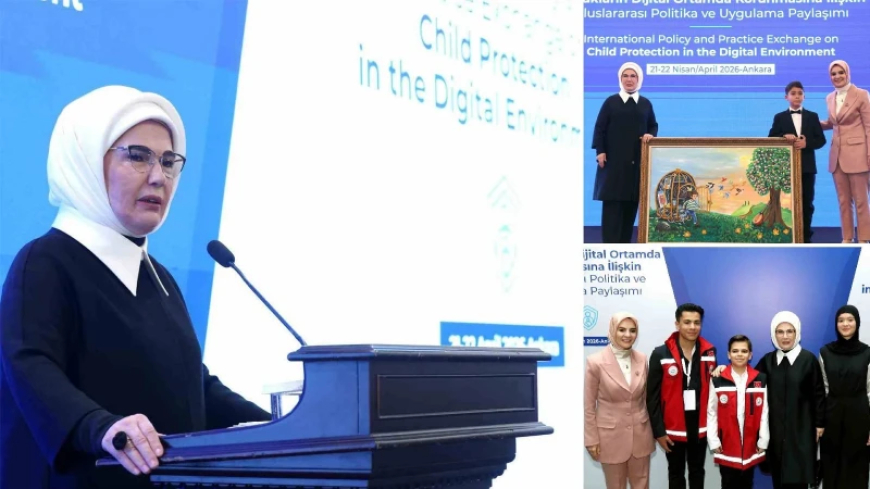
ANKARA, TURKEY — As the digital landscape increasingly dictates the social and cognitive development of the next generation, Turkey is amplifying its call for a coordinated global response to the escalating threats facing children online. First Lady Emine Erdoğan, speaking at a high-level international forum organized in collaboration with UNICEF and the UN, delivered a stark warning regarding the "boundlessness" of the digital age, framing the unchecked expansion of online platforms as an existential threat to childhood safety and psychological well-being.
During the "International Policy and Practice Sharing on the Protection of Children in the Digital Environment" meeting, hosted by Turkey's Ministry of Family and Social Services, Erdoğan articulated a vision that moves beyond parental anxiety. Instead, she outlined a comprehensive strategy demanding systemic changes, corporate accountability from tech giants, and robust legal frameworks to establish digital "safe zones." The summit, attended by ministers and social policy directors from across Europe, Central Asia, and Africa, highlighted a growing international consensus: the responsibility of protecting children online can no longer rest solely on the shoulders of overwhelmed parents.
The silent epidemic of online abuse
The core of the First Lady's address focused on the alarming scale of the crisis. While acknowledging the undeniable educational and developmental opportunities afforded by the internet—such as AI-supported learning tools and global knowledge networks—Erdoğan emphasized the severe vulnerabilities embedded within these same platforms.


"Children can access information and millions of resources with a single click in the digital world," Erdoğan noted. "But unfortunately, in the same world, all kinds of abuse reach children at the same speed."
She cited sobering global statistics, highlighting that more than 300 million children are subjected to online abuse and harassment annually. "The frequency of these cases dropping to one every 10 seconds clearly reveals the dimensions of this 'hidden epidemic' that surrounds every country, every household, and every school," she warned. This staggering volume of digital exploitation requires an immediate shift from reactive measures to proactive, structural safeguards.
The dilemma of the 'Digital Immigrant' parent
A significant portion of the discourse centered on the generational divide that tech companies have exploited. Today's youth are not merely utilizing digital spaces; they are constructing their identities, social relationships, and core values within them. Meanwhile, parents and regulators have frequently been marginalized in discussions concerning online governance.
Erdoğan sharply criticized the prevailing narrative that characterizes concerned parents and proactive governments as adversaries of progress. "Unfortunately, as adults, we have been pushed out of this world with the 'digital immigrant' label pasted on us," she observed. She noted that efforts to establish boundaries in a world where children are declared 'natives' have routinely been obstructed by accusations of censorship.


"Parents were accused of being behind the times whenever they voiced their concerns. When regulations on digital media became the subject of social policies, governments were accused of being oppressive," Erdoğan stated. The consequence of this unregulated expansion, she argued, is an environment saturated with cyberbullying, digital addiction, the misuse of personal data, and exposure to violent and discriminatory content. "Today, we are paying the price for this boundlessness with the damage caused to the spiritual, mental, cognitive, social, and physical development of children."
A call for global corporate accountability
Turkey's approach, as articulated at the summit, insists that securing the digital realm requires a multi-stakeholder alliance. The responsibility must be equitably distributed among families, public institutions, international organizations, the media industry, and, crucially, technology companies.
"It is an absolute necessity, especially for technology companies, to be accountable and to create child-friendly designs," Erdoğan emphasized. This demand for "child-friendly design by default" aligns with growing international pressure on Silicon Valley to alter algorithms that prioritize engagement over user safety.
To codify these principles, Turkey has launched the 'Declaration on Children's Rights in the Digital World' (Dijital Dünyada Çocuk Hakları Sözleşmesi). Initiated by the Ministry of Family and Social Services and previously signed by President Recep Tayyip Erdoğan, this 13-point declaration aims to expose digital threats, call society to take responsibility, and raise international awareness. The First Lady utilized the UNICEF summit to invite all international stakeholders to sign the declaration, promoting it as a foundational text for global digital governance regarding minors.
Legislative action and establishing boundaries
Moving beyond rhetoric, Turkey is currently evaluating concrete legislative measures. Aligning with a growing global trend seen in countries like Australia, France, and Denmark, the Turkish Grand National Assembly is reviewing a draft law aimed at regulating social media access based on age.
"I am happy to say that there is almost a global awakening on this issue," Erdoğan remarked. The proposed legislation in Turkey plans to restrict social media access for children under the age of 15. For youth over 15, the law aims to mandate age-appropriate, segregated services and mandatory parental control tools.
Erdoğan framed these restrictions not as limitations, but as necessary architectural boundaries for healthy development. "Just as technology has the potential to move humanity forward with the benefits it provides, it can threaten the future of humanity if left uncontrolled," she argued. "If we lose control, our children's lives can suddenly be invaded by digital nannies, digital friends, and digital playgrounds. This is exactly why we need solid boundaries."
The summit concluded with a clear mandate: the era of tech exceptionalism must end. By fostering international cooperation, sharing best practices, and demanding accountability from digital platforms, nations can begin to reclaim the digital environment, transforming it from a landscape of hidden risks into a secure foundation for the next generation.